
Reuters report: social media has become the primary channel for news access
The Reuters Institute released its 2026 Digital News Report, based on survey data from more than 85,000 respondents across 48 regions, revealing that social media has become the primary channel for global news consumption. The report shows that social platforms lead television and news websites in total news distribution, with increased reliance on social apps across all age groups. The influence of TikTok and Instagram is rising, while platform X is declining due to audience fragmentation, and Threads is gradually gaining attention as an alternative. Meanwhile, the rise of AI chatbots as a news source, as well as the potential impact of the creator economy on information accuracy, have become new trends worthy of caution.
Reuters Institute recently released its Digital News Report 2026, which provides a comprehensive examination of the current state of the information ecosystem and how people's ways of accessing news are undergoing structural changes.
Based on survey data covering more than 85,000 respondents across 48 regions, this annual report offers a clear snapshot of modern news consumption patterns and the key factors influencing public opinion.
The report shows that social media has now become a core driver of news dissemination—an increasing number of respondents say social platforms are their most frequently used daily news source. This result is not surprising, yet it marks a profound shift in the media consumption landscape.

As shown in the figure above, social platforms now lead television and news websites in overall news distribution channels. More and more people tend to discover news within social applications rather than relying on other digital input channels for information.
This trend also means that social media users' influence over the perception of news narratives is growing.
In fact, data from another section of the report shows that in many regions, online content creators are emerging as key news sources.

The challenge here lies in the fact that social platforms are driven by algorithms, which may be manipulated by platform owners; meanwhile, online creators often prioritize engagement or external sponsorship over accuracy.
This mechanism has the potential to facilitate the spread of misinformation, or at least lead to certain topics being reframed to chase audience interest, deviating from the facts themselves.
The report also shows that respondents across all age groups said their reliance on news content from social applications has increased compared to other online information sources.

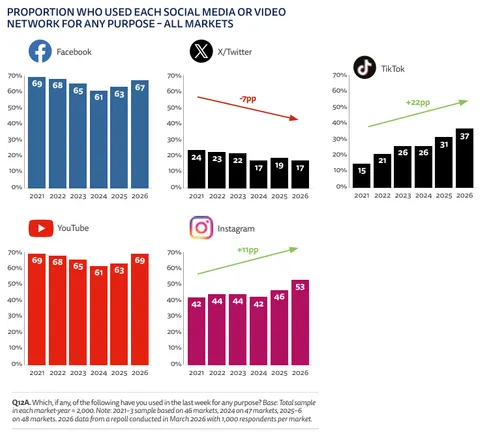
In terms of specific platforms, the overall influence of TikTok and Instagram is on the rise, while X's share in news usage has declined.

Changes within the X platform have led to a fragmentation of its audience, with Threads gradually gaining attention as an alternative. This shift, triggered by Elon Musk's acquisition of X, seems to have weakened X's value as a key news platform.
Meanwhile, the use of AI chatbots as a news source is also on the rise.

Given the frequent occurrence of AI hallucinations and factually incorrect responses, this trend warrants caution—more and more people are treating information provided by AI bots as fact without verifying it through external sources.
Overall, the Digital News Report 2026 highlights key trends across multiple dimensions of media consumption, as well as various factors influencing public opinion.
The high concentration of social media in news distribution appears to constitute a vulnerability in information flow and accuracy. Particularly concerning is the fact that both platforms and influencers are driven by the imperative to boost engagement at all costs.