
Pinterest reports solid Q1 2026 results with 12M new users and 18% revenue growth
Pinterest's Q1 2026 earnings show continued momentum: 631 million monthly actives (up 12 million quarter-over-quarter), 18% year-over-year revenue growth, and a 24% increase in ad impressions. However, revenue per user dipped sequentially across all regions, and ad pricing fell 5% year-over-year. CEO Bill Ready credited AI investments for ten straight quarters of double-digit user growth.
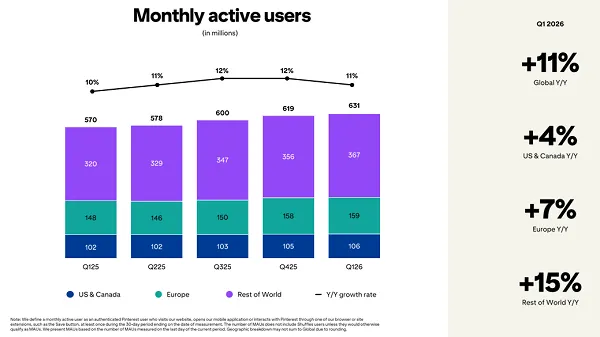
Pinterest delivered solid results for the first quarter of 2026, adding 12 million net new users compared with the prior quarter and posting 18% year-over-year revenue growth, as the company continued to strengthen its position as a key product discovery platform.
User growth: global expansion leads the way
Pinterest now reports 631 million monthly active users, up from 570 million in Q1 2025. The company noted that its user figures are rounded, so geographic breakdowns may not sum exactly to the global total.

The vast majority of new users came from the "Rest of World" category, according to the company's geographic breakdown. By contrast, Pinterest added a comparatively modest one million users in both the U.S. and the EU during the first three months of the year.
Growth is growth, and adding 12 million users is significant in absolute terms. However, Pinterest generates considerably higher revenue per user in the U.S. and EU—its key markets—than in developing regions where the platform is gaining traction.
Revenue and monetization trends

As the charts illustrate, Pinterest's year-over-year revenue per user is increasing, but on a quarterly comparison this metric declined in every region during Q1. Total revenue also dipped relative to Q3—a pattern the company attributes to seasonality, as Q4 typically delivers stronger results—though it remained above $1 billion for the first quarter of 2026.

On a constant currency basis, Pinterest said revenue would have grown 15% year over year. CEO Bill Ready told analysts on the earnings call that the company's first-quarter numbers came in stronger than expected.
AI investments drive engagement
Ready highlighted the development of Pinterest's artificial intelligence-powered discovery graph, which he said is driving stronger engagement. He elaborated: "Ten straight quarters of double-digit user growth are the direct result of multi-year investments in AI and improving personalization and curation within visual search and discovery. At the center of this is our Taste Graph which captures visual intent and curation signal built on hundreds of billions of user interactions over a decade."
Ready also noted that the performance of its AI-powered Performance+ ads is improving, with advertisers using Performance+ seeing higher return on ad spend (ROAS) and improvements in cost per acquisition (CPA) and cost per click (CPC) compared with business-as-usual campaigns.
Ad impressions up, pricing down
Chief Financial Officer Julia Donnelly reported on the earnings call that ad impressions grew 24% in Q1. Meanwhile, ad pricing declined 5% year over year, which she said was "primarily driven by lapping the initial ramp of monetization in previously undermonetized markets, including from resellers and Rest of World, which had contributed to outsized impression growth the prior year."
International expansion remains a priority
Expanding revenue beyond the U.S. and EU remains a central focus. Donnelly said the company plans to broaden its revenue base globally with the appointment of a new, as-yet-unnamed head of international growth, tasked with driving new opportunities.
Donnelly also addressed the ongoing impacts of world events on the business. "We're still significantly under-monetized internationally relative to the strength of engagement and commercial intent we see on the platform," she said. "Our long-term conviction in the opportunity in international is unchanged and we think the changes that we're making now best position us to fully capture that opportunity over time."
Overall, Pinterest's expanding user base across more regions should present greater revenue potential over time, provided the platform can boost advertiser adoption in these markets.