
TikTok Report: Creative AI Optimization Demands Cultural Intelligence, Not Just Volume
Marketing strategy group Warc, in partnership with TikTok, released a report examining how AI tools reshape creative workflows. Surveying 400 marketers across the U.K., U.S., Australia, and Brazil, the study finds that AI boosts efficiency but cannot replicate cultural relevance. TikTok's Global Head of Creative and Brand Ads Andy Yang emphasizes learning speed over content volume. Marketers report AI's lower value in copywriting and scripting, citing concerns about originality. The report suggests integrating cultural insights from platforms like TikTok to refine AI outputs and enhance campaign resonance.
Marketing strategy group Warc has partnered with TikTok on a new report that investigates how artificial intelligence tools are influencing marketing workflows. The study also examines how marketers can integrate community insights to drive better AI outputs and improve overall campaign performance.
The research draws on feedback from 400 marketers across the U.K., U.S., Australia, and Brazil, offering a broad view of how generative AI has impacted the creative advertising sector. According to the report, the defining content trend of the moment is relevance rather than volume—a quality that AI tools cannot fully replicate.
“The brands winning today are not the ones generating the most content,” said Andy Yang, TikTok’s Global Head of Creative and Brand Ads, in the report. “They are the ones learning fastest from the people they serve. That speed of learning is what we call cultural intelligence: the ability to read what a community values, in the moment it is forming that value, and to respond with something that feels native rather than inserted.”
The expanded push for AI adoption has placed marketers under pressure to produce more assets, with AI tools enabling faster and broader workflows. Most marketers surveyed found AI tools useful for this purpose, and a majority agreed that AI has become a central part of the creative process.

However, when it comes to copywriting and scripting, the perceived value of AI tools ranks lower. This suggests that while AI can support and facilitate new ideas, simple automation systems cannot handle the entire creative process without human intervention. The report also highlights AI’s weaknesses, particularly concerns about its lack of creative originality.

To address these gaps, marketers indicated that more cultural insights could help improve the relevance of AI outputs. This is where TikTok’s role becomes pivotal.

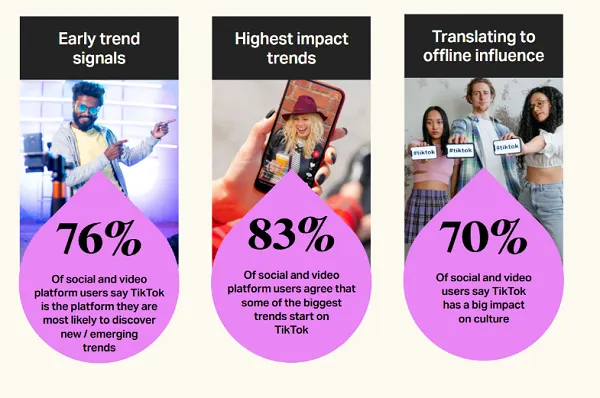
According to the study, TikTok’s cultural influence can help guide creative approaches by tapping into what is gaining traction at any given time. Understanding these trends and applying them to creative strategy could help marketers better align with their target audiences, enabling brands to create content that resonates and sparks conversations.

Using this framework, the data shows that marketers can refine their creative briefs to better align with what is working. Meanwhile, AI tools can help interpret key signals and drive improved creative choices. The full report includes in-depth breakdowns of each element and offers insights into how marketers can make better use of data signals to drive their strategies.

In other words, AI serves as a complementary component that can enhance community connection, but it requires the right context to shape its outputs effectively. Platforms like TikTok can provide the relevant insight and bring together these two elements to power a more effective strategy.
Informa, which owns a controlling stake in Informa TechTarget, the publisher behind Social Media Today, is also invested in WARC and Omdia. Informa has no influence over Social Media Today’s coverage.