
Snapchat's Q1 user numbers decline in US and European markets, while advertising business remains stable
Snap Inc. released its Q1 2026 financial results, showing that Snapchat's global daily active users grew to 483 million, but user numbers in North America and the European Union continued to decline, with advertising revenue up 12% year-over-year.
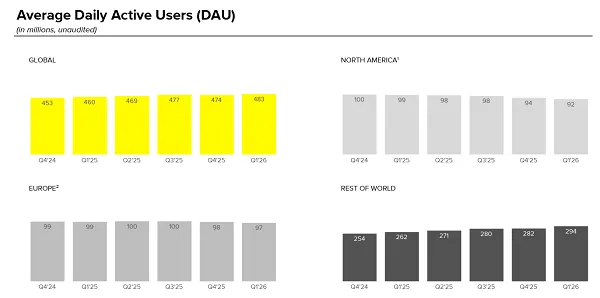
Snap Inc. (the parent company of Snapchat) recently released its Q1 2026 earnings report. The data shows that Snapchat's user engagement in its key markets continues to decline, but its advertising business remains stable.
First, looking at user data, Snapchat's daily active users (DAU) increased by 9 million compared to the Q4 figures, reaching 483 million. This result is significant because in the previous reporting period, Snapchat's DAU had decreased by 3 million quarter-over-quarter.

However, the overall growth is not reflected in Snap's key markets.
In North America (Snapchat's primary source of revenue), the app's DAU decreased by another 2 million to 92 million; while in the EU, Snap's user base declined by 1 million compared to the previous quarter.
In other words, all of Snap's growth comes from regions where its business tools are still under development, and these regions generate relatively lower revenue.

Snapchat is working to improve this situation, but as shown in the chart above, Snap's revenue per user in its growth regions remains significantly lower than in other markets.
Therefore, while overall growth is a positive signal, it still poses certain issues for Snap unless the platform can find ways to generate more revenue from these users.
Another key challenge Snap faces is the growing global call for age restrictions on social media use. Many regions are following Australia's lead,implementing bans on social media use for users under 16to limit the negative effects of social media use and exposure.
Given Snapchat's high popularity among younger audiences, this could impact it more significantly than other platforms.
In February of this year,Snapchat reported thatthe Australian teen ban had already forced it to lock or disable 415,000 accounts. Australia's population is approximately 27 million, so it is not hard to imagine that if countries like Germany (84 million), the UK (69 million), or Spain (49 million) alsoconsider implementing teen social media bans, the impact would expand significantly.
The cumulative effect could have a major impact on Snap's overall growth plans, making this another significant risk factor for the app.
Snapchat also reported that monthly active users (MAU) increased from 946 million in Q4 to 956 million.
In terms of revenue, Snapchat generated $1.53 million in revenue this quarter, up 12% year-over-year.

Snap stated that Sponsored Snaps drove strong performance, with dynamic product ad revenue growing over 30% year-over-year, particularly driven by growth among small and medium-sized business customers.
Thus, Snap is diversifying its advertising revenue sources and driving more growth through a broader brand portfolio. Although growth is currently stable, future expansion will be largely tied to overall user engagement.
Essentially, Snapchat needs to maximize its commercial opportunities in more regions, as its user decline in the US and EU will limit its growth potential.
Additionally, its costs remain high:

Snapchat has beenworking to cut costsand improve overall profitability, while continuing to develop its advertising business and expand based on existing opportunities.
But the challenges are evident.
Snap CEO Evan Spiegel has described this phase as a"critical moment"for the app, as it must compete with tech giants while also fending off emerging startups vying for its core market.
Although Snapchat's growth has largely slowed and reversed in key markets, it remains a core app for many users. The issue is that as these users age into higher demographics, Snapchat has not managed to maintain its key position, so its opportunities are inherently limited, and its market value is constrained to some extent.
Snap has been trying to break this pattern by seeking new advertising opportunities, such asplacing ads in users' private messagesand expanding ad placements to help advertisers reach its influential audience. But there are limits to this as well, and it seems only a matter of time before Snap users start complaining about ad overload disrupting their social connection experience.
Judging by the overall growth strategy Snapchat presented to investors last month, the road ahead does not seem easy.

Snapchat is still working toward the first goal mentioned above, but as noted earlier, growth in its important markets is regressing, so the final results may not be as impressive as the overall data suggests.
In recent years, Snapchat's innovation has not seen major breakthroughs, aside from the Spotlight feature borrowed from TikTok. Although subscription revenue is growing, Snapchat+ revenue can never compare to advertising revenue.
So what remains is attracting more advertisers by improving ad performance, but this could become a problem if users grow tired of excessive ads.
Additionally, there are the AR glasses, which Snap still plans to launch this year.
But Snapchat's bulky, heavy AR device seems to have beeninferior to Meta's AI glassesfrom the start, and even with advanced AR features, I am not sure consumers will have strong demand for the device.
If Meta releases its own AR glasses in 2027 as planned,as it has outlined, I expect Snap's AR wearable will not be a big winner either.
So Evan Spiegel is right—this is indeed a critical moment, a major test of Snap's competitive ability. Now, we will wait and see.