
Snapchat: Teenagers' Nature Unchanged, but Digital Spaces Have Transformed Their Social Interactions
Snapchat partnered with Omnicom Media and Alter Agents to survey teenage users across five global markets, releasing a new report on teenage social behavior, content consumption, and AI usage. The report shows that teenagers still engage in traditional social activities, but these increasingly occur on digital platforms; they generally hold skeptical views toward online content, and the 13-15 age group is significantly more optimistic about AI than the 16-18 age group.
Snapchat recently released new insights into how teenagers interact online, revealing the roles of social platforms and creators, providing more perspectives for understanding current teen usage trends. The report was produced by Snapchat in collaboration with Omnicom Media and Alter Agents, covering five global markets, aiming to directly understand how young users handle interpersonal relationships, content consumption, and technology use.
The report offers interesting and potentially valuable information for marketers and the broader adult audience, particularly focusing on how teenagers view social media as a tool for connection.
Snapchat noted in the report: "This generation hasn't changed what it means to be a teenager. They still keep in touch with friends, gossip, do homework, and explore relationships—just more often in digital spaces, often with the help of social platforms. However, while maintaining their teenage traits, they've also developed adult-like habits of questioning everything they see online. They frequently verify news, check AI-provided information, and many don't fully trust what they see on social media."

Notably, skepticism toward online content is rising among young users. This trend could have a positive impact on how future generations handle misinformation, especially as AI tools become increasingly adept at simulating content and events.
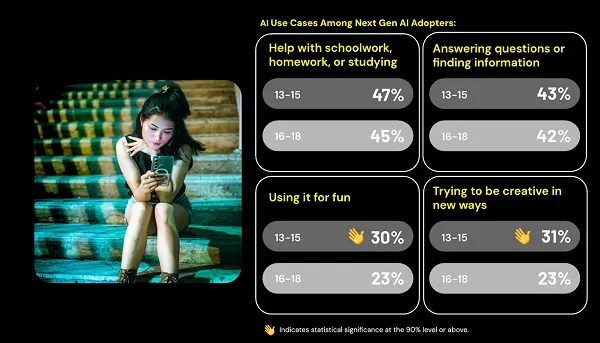
AI is one of the core focuses of this report. Researchers also explored how teenagers view interactions with AI and the value of these evolving tools.

Interestingly, the data shows that younger teens (ages 13-15) are more optimistic about AI, with 55% believing AI will have a "mostly positive" impact on their generation's future, compared to only 37% of teens aged 16-18.
The report also examined how teenagers allocate their time and how they interact with friends both online and offline.

Logically, older teens spend more time on real-world interactions with friends, while younger teens, due to less freedom to go out, rely on online interactions as a key part of their social process, highlighting the important value of digital platforms in this regard.
This finding stands in long-term opposition to the premise of teen social media bans. Those bans targeting young users suggest that using social apps negatively impacts social engagement, aiming to encourage more offline behavior and protect teens from potential harm. However, a better solution might be enhancing digital literacy education.
Snapchat's report also focused on offline activities popular among teens.

Additionally, the report examined the influence of online creators in teen entertainment and content engagement.

These insights offer an interesting reference for understanding the perspectives of young audiences and how they integrate online content and AI into their lives.
The report is valuable not only for market research but also for broader understanding of what these trends mean for the next generation of consumers and overall technological development.