
Meta Data Center VP Defends Expansion Amid Water, Power Concerns
Meta published an interview with VP of Data Centers Rachel Peterson on Thursday, addressing the company's massive U.S. data center expansion. Peterson outlined benefits for local economies, detailed site-selection criteria, and responded to criticism over water consumption and utility impacts. The interview comes as community opposition grows, with over 300 localities enacting bans or moratoriums on hyperscale projects.
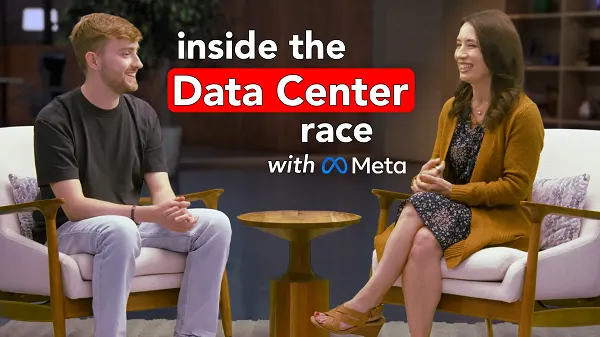
Meta published an interview with its Vice President of Data Centers, Rachel Peterson, on Thursday, as the company faces intensifying community backlash over its sprawling data center developments across the United States. In the conversation, Peterson highlighted the benefits of the expansion and detailed how Meta aims to support local economies.
During the 16-minute clip, Peterson discussed the company's approach to data center development and outlined several factors that inform its site-selection process.
Peterson first addressed Meta's stated goal of delivering "personal superintelligence" to every user, explaining that achieving this ambition would require vast data processing capacity to power its artificial intelligence initiatives.
She described her personal view of personal superintelligence as "having the utmost experts who understand your unique preferences, your unique ways of wanting to operate, that is personalized to you, that makes you the most effective and efficient person that you can be."
To deliver this level of personalization and utility at scale, Meta's AI tools require substantial data processing infrastructure, which is why the company has accelerated its data center construction program. Meta has committed more than $600 billion to U.S. data center projects over the next three years.
Peterson noted that the majority of Meta's data center development work has been initiated over the past two years as the company ramped up its program.
However, these projects have also produced negative consequences in several regions.
In Morgan County, Georgia, Meta's data center operations have been linked to water contamination and utility impacts, prompting Rep. Alexandria Ocasio-Cortez to call for federal action to limit the development. In Fayetteville, Georgia, Politico reported that an AI infrastructure project drained 30 million gallons of unmetered water, affecting local residents. Meanwhile, in Northern Virginia, data center projects in Loudoun and Fairfax counties consumed nearly 2 billion gallons of water in 2023, according to The Bulletin of Atomic Scientists, forcing local water authorities to rely increasingly on potable water rather than reclaimed water for cooling purposes.
The community backlash has contributed to a notable decline in public support for these projects, despite Meta and other technology firms emphasizing long-term economic benefits.
According to a recent report by Time Magazine, only a third of Americans approve of the current pace of data center development. Additionally, more than 300 cities, towns, and counties have enacted bans or moratoriums on the construction of hyperscale data centers.
On July 18, a national day of protest against data centers drew 142 demonstrations across 42 states.
Addressing efforts to limit negative impacts, Peterson said Meta's assessment process for potential data center locations includes evaluating requirements for power, water, labor availability, and other resources to facilitate the most efficient construction possible.
Peterson also discussed Meta's approach to community engagement. She stated that the community "has to be a place where we're going to put our roots down for 20 years, and that means we want to be part of the community."
She added that Meta works to restore more water than it consumes and collaborates with utility grid providers in data center regions to secure necessary resources while minimizing effects on local residents.
Peterson further claimed that Meta's infrastructure support efforts sometimes lower utility costs in certain data center areas by improving local grid efficiency.
"I think this is a misconception that people may have of us and other data centers coming in and taking more than their fair share, [and] passing on costs, when in reality, our investments are oftentimes helping the electric grid bring reliability and consuming costs that otherwise would have been passed onto everyday residential consumers," Peterson said.
She also noted that Meta's data centers are designed as closed-loop systems, meaning they do not discharge waste, and that water usage at its facilities is "pretty minimal."
The interview represents Meta's latest effort in a broader public relations campaign to counter concerns about its data center projects, aiming to preserve community support and smooth the path for future developments.
In June, Meta launched a new initiative called America's Workforce Academy, which partners with construction-related organizations to provide training and job placement opportunities in regions where the company is building its data processing infrastructure.
Through these combined efforts, Meta hopes to alleviate concerns and win broader public approval for its development strategy. Yet, as more regions continue to report issues related to data center growth, the company may still encounter additional resistance.