
Snapchat Report: Health and Medical Advice Becomes High-Frequency Use Case for Users
A joint survey by Snapchat and Ipsos shows that among US daily active users aged 18-45, 95% are interested in health, 58% rely on social platforms to research complex health topics, and 61% use them to compare treatment options. Although Snap views this as a marketing opportunity for pharmaceutical companies, concerns about the reliability of online health information have been raised.
Snapchat recently released a report exploring how its users prioritize health and wellness, and how they use information obtained from social media to guide health decisions. The report, conducted by Snapchat in partnership with Ipsos US, is based on a survey of 1,500 users in the United States aged 18 to 45 who use social media daily and express an interest in health and wellness.
The data reveals the growing influence of social media in health content consumption, while also highlighting Snapchat's potential as a tool for disseminating important health information. Snap Inc. attempts to frame the results as a positive signal for health marketers, but this interpretation has raised some questions.
Snap noted in the report: "Health management is no longer confined to the doctor's office, but extends to conversations on social platforms." This statement may raise concerns, but Snapchat views it as a positive factor for pharmaceutical advertisers. Snap further explained: "Users are no longer passively waiting for appointments, but are actively researching, validating, and managing their own health and wellness in real time." However, the reliability of online health research has long been criticized, yet more and more people are choosing to look up health information online on their own.
Survey data shows that 95% of Snapchat's daily active users have an active interest in health and wellness, and Snapchat users are 1.2 times more likely to purchase health and wellness products than non-users. Additionally, 58% of daily active users say social platforms help them research complex health topics, and 61% use social platforms to compare different brands or treatment options.

Relying on social media for medical information can carry risks, but as healthcare costs continue to rise, more people are turning to the internet for help. Whether this constitutes a marketing opportunity remains an open question.
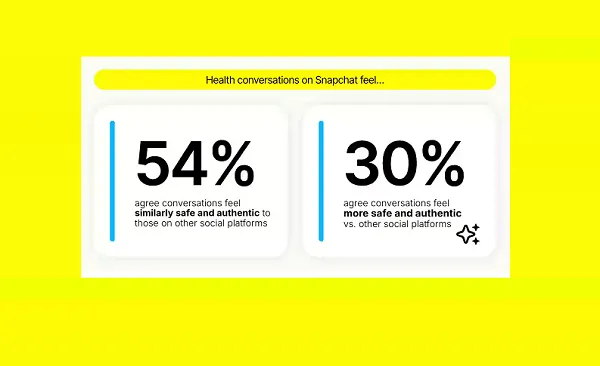
The research also shows that Snapchat is perceived as a uniquely trustworthy space for health-related discussions—compared to other social platforms, conversations within the app are considered safer and more authentic. Specifically, 71% of daily active users say they are willing to share health-related Snap content with close friends. Snap commented on this: "This safe space creates a halo effect for advertisers, allowing brand content to foster genuine education and real-world decisions."

In some cases, this view seems to hold: people do search for health information online, and pharmaceutical brands that meet this need by offering relevant solutions for common conditions may find success. However, the growing reliance on internet medical information could also be a dangerous area that raises more questions. Therefore, it may not be appropriate to simply view it as a marketing opportunity.
Regardless, Snap is advancing this narrative by emphasizing the platform's value in sharing non-professional health advice.
