
Instagram expands service to Samsung smart TVs and tests personalized channels and landscape videos
Instagram announced that it is expanding its updated TV app to Samsung smart TVs in the U.S. market, extending its reach to most connected TV devices in the country. At the same time, the platform is testing new experiences such as personalized channels, Stories on TV, and landscape videos, while exploring scenarios for long-form videos and live interaction.
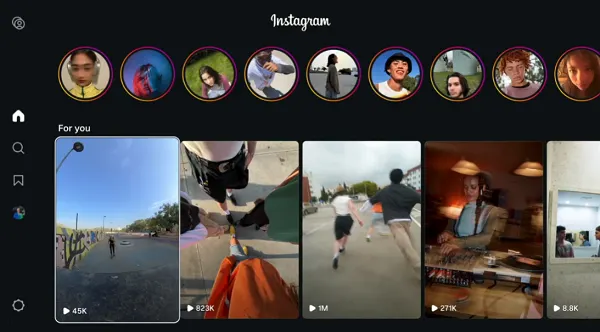
Instagram recently announced that it is expanding its TV app to Samsung smart TVs in the U.S. market. Following this update, Instagram's TV app will cover most connected TV devices in the United States. At the same time, the platform is testing several connected TV viewing features, including personalized channels, Stories for TV, and landscape videos.
According to Instagram's official announcement, this expansion means its improved TV app is now available on mainstream connected TV devices in the U.S. Previously, Instagram launched a redesigned TV app for Amazon Fire devices in December 2025, and its new connected TV experience is designed with reference to YouTube's TV app.

This layout logic is clear. Connected TV has become one of YouTube's fastest-growing use cases. According to data from Alphabet's Q4 2024 earnings call, Shorts viewing on TV accounts for 15% of total Shorts consumption within the YouTube app in the U.S.
Most of the growth in time spent within the Instagram app comes from Reels consumption. Given the trend of short-form video viewing on connected TV, Instagram clearly sees an opportunity for expansion in this direction. In February, Instagram expanded its connected TV app to more devices, including Google TV devices in the U.S. market.
Whether users will use Instagram on TV as readily as they do YouTube remains to be seen. But Instagram is clearly committed to this expansion and hopes to drive more usage through it.
In addition to expanding device coverage, Instagram will also launch a channels feature on Instagram TV, as well as Stories content presented in a vertical format, adapted for large-screen display.

At the same time, Instagram is testing a separate entry point specifically for landscape videos, as the landscape format is better suited for a full-screen TV viewing experience.

Additionally, Instagram has added the ability to send Reels from the mobile app to TV, making it easy for users to share content on the big screen.
The platform is currently working with creators on several experiments better suited for large-screen viewing, involving long-form videos and episodic content. Finally, Instagram is also developing improved live viewing options for connected TV, which are expected to support interactive features during live streams.
It should be noted that whether Instagram users are willing to browse platform videos on a TV screen is still uncertain. Instagram's past attempts at connected TV viewing have not shown significant results, and its previous IGTV app was shut down after four years of operation.
However, now may be the right time for IGTV to return in a new form. As Instagram encourages creators to shift toward long-form mini-series and episodic content, there may be an opportunity in this direction if the platform can precisely match target audiences.
If TV app usage can scale, this could also open up new advertising inventory potential for the platform.